Em’s Death After Comforting Ish
Earth AbidesEm’s death is both a private bereavement and a turning point in Ish’s understanding of what will endure: as he sits beside the woman he loves, she comforts him about their descendants and releases him from the fear that civilization must be restored for life to have a future. Her decline makes Ish confront the limits of his knowledge and courage; her final reassurance gives the family’s survival a meaning beyond his own ambitions.
Illness and the Limits of Intervention
By the year after The Tribe had become divided into The First Ones and The Others, Ish saw that Em no longer walked with her former regal grace. Her face carried lines of pain, and the color beneath her cheeks had become ashy. The change made him feel that something precious was nearing its end, though he did not yet know what her illness was.
In the months that followed, Ish repeatedly considered whether the pain might be appendicitis. He had books from which he could learn an operation, and he imagined that one of the boys might administer ether. He even reasoned that, at worst, surgery might end the pain. But the possibility of acting on that knowledge brought him up against his own limitations: his hands were no longer young and sure, and he feared that his courage had weakened. Most of all, he could not bring himself to draw a knife across the side of the woman he loved. His medical reading could not make him a surgeon, and his wish to relieve suffering could not settle the risk of trying.
As time passed, Ish understood that the illness was not appendicitis. When the sun swung southward again, Em grew weaker and could no longer walk. He searched the ruined drugstores and found powders and syrups that eased her distress for a time. After taking the medicine, she could sleep or lie quietly, smiling; when the pain returned, Ish again thought about whether a larger dose might end it permanently. He did not give one. He knew that Em had always reached toward life and that her courage had not failed. His care therefore took the form the circumstances allowed: finding what medicine he could and remaining beside her.
Em Comforts Ish and the Family
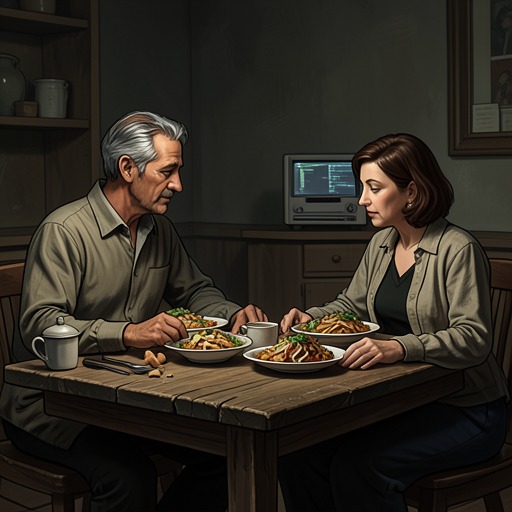
Ish spent long hours holding Em’s hand, and they talked now and then. Even while she lay in pain and was dying, she continued to comfort him. He recognized that she had been mother as well as wife—a role that made her presence larger than their marriage alone and made his coming loss feel like the loss of a source of care for the whole family.
Em directed her final reassurance toward the children, grandchildren, and descendants still to come. She told Ish, “Don't worry,” she said once, “about the children, I mean—and the grandchildren and all those that will come after. They will be happy, I think. At least, they may be as happy as they would have been otherwise. Don't care too much about that civilization. They will go on!” Her words do not promise that the old world will return, or that the future will be free of hardship. Instead, they challenge Ish’s tendency to measure the future by whether civilization can be recovered. The descendants’ lives, she suggests, need not be judged against the world that preceded them.
The family’s presence gives that reassurance visible weight. Josey, herself a mother, cared for the house and for Em. The tall sons, strong daughters, and grandchildren came to the bedside; the oldest grandsons were growing tall, while the granddaughters showed the fullness of womanhood. Seeing these generations pass Em’s bed, Ish understood that she was right. The people who would continue were not a restoration of the old civilization, but they were living proof that the family’s future did not depend on its return.
Death and Burial
At last, while Ish again held Em’s hand, he sensed a third, dark presence beside them. Em could no longer speak. He felt only one light flutter of her fingers in his hand. The small gesture marks the final contact between them: speech has ended, but Ish is still physically holding her when her life passes.
Ish’s thought of Em as “Mother of Nations” enlarges the loss from the intimate bedside to the descendants she has helped bring into the world. He imagines her sons praising her and her daughters calling her blessed. Then the presence that had made three becomes two: Death has gone, and Em has gone with it. Ish sits bowed and dry-eyed. The narration does not turn his grief into an outward display; its force lies in the finality of what has happened and in the plain fact that he remains with the dead.
The family will bury Em without a marker, following the custom of The Tribe. That absence matters: her place in the family will not be preserved by a named stone, but by the people gathered at her bed and the generations she told Ish would go on. The moment recalls the beginning of love and sorrow in the world, linking this particular death to a human experience older than the society that has collapsed around them.
What Em’s Death Leaves Behind
After Em’s death, Ish recognizes that “greatness had passed from them.” The judgment does not cancel her reassurance. Instead, the two thoughts hold different kinds of truth: Ish feels that an exceptional presence has left his life, while the family’s continued growth confirms that ordinary life will continue without her. The contrast makes the loss irreducibly personal even as it opens onto a future beyond the couple.
The narrative sets Ish’s preoccupation with recovering civilization against Em’s confidence in the descendants themselves. She does not dismiss his efforts or claim that the old world is unimportant; she tells him not to care too much about civilization and insists that the children and those after them will go on. Her death gives that claim its immediate cost: Ish must live on without the person who had repeatedly comforted him, while the family she names remains around him.
The years continue to be marked on the rock after her death, as the sun swings north and south past the Golden Gate. Em’s passing is therefore neither the end of the family nor an uncomplicated promise of renewal. It is the end of Ish’s life with his wife, the loss of the person he understood as both mother and companion, and a moment in which the continuing generations become the answer to his fear that everything meaningful must disappear with civilization.